Eyelash Extension Damage: 7 Myths & Prevention Truths for Salons 2026
Share
Author: LASHMAITRE Team
Topic: Lash Health & Safety
Reading Time: 25 Minutes
Introduction
In the beauty industry, there is one phrase that strikes fear into the hearts of potential clients and keeps ethical salon owners awake at night: eyelash extension damage. It is the number one objection during consultations and the primary reason clients churn. The internet is flooded with horror stories of bald eyelids and traction alopecia, creating a stigma that professionals must fight daily.
However, in 2026, the narrative has shifted. We now know definitively that eyelash extension damage is not an inherent side effect of the service; it is a symptom of poor technique, incorrect weight calculation, or sub-par products. When applied correctly, extensions can actually protect natural lashes from the daily wear and tear of mechanical curlers and mascara removal.
This comprehensive guide serves as your salon’s safety manifesto. We will debunk the myths, expose the mechanical causes of injury like identifying lash stickies, and provide you with a data-driven lash extension weight safety chart to ensure your team delivers flawless, healthy results every single time.
The Business Impact: Why Damage Control is Retention Strategy
Before we dive into the biology, let’s talk business. Ignoring the signs of damage is financial suicide for a salon.
The Churn of Regret
A client might leave your salon looking fabulous, but if she wakes up three weeks later with gaps in her lash line or pain at the follicle, she won’t blame her biology; she will blame you.
- The Cost: Acquiring a new client costs 5x more than retaining an existing one. Eyelash extension damage destroys retention.
- The Reputation: In the era of social media, one photo of a damaged lash line can go viral locally, destroying trust that took years to build.
Data Insight: The Safety Premium
According to Grand View Research and 2026 consumer sentiment analysis:
- Priorities: 72% of lash clients rank “Health of Natural Lashes” as their top priority, even above “Price” and “Style.”
- Willingness to Pay: Clients are willing to pay 20-30% more for a “Certified Safe” artist who conducts a proper
natural lash health assessment. - Damage Reports: Sadly, 40% of first-time clients report experiencing some form of discomfort or breakage, highlighting the massive gap in industry standards.
Myth vs. Reality: Does Lashing Ruin Natural Lashes?
As a professional, your first job is educator. You must dismantle the myths surrounding eyelash extension damage to put your clients at ease.
Myth 1: “Lashes Need to Breathe”
- The Myth: Clients believe they need to take a break every few months to let their lashes “breathe.”
- The Truth: Hair does not have lungs. It needs oxygen from the blood supply at the follicle, not from the air.
- Prevention: As long as the follicle is not stressed by excess weight, continuous wear is perfectly safe. Eyelash extension damage comes from weight, not suffocation.
Myth 2: “Extensions Make Your Real Lashes Shorter”
- The Myth: Clients often feel their natural lashes are shorter after removal.
- The Truth: This is usually a psychological adjustment (getting used to the length of extensions). However, if
preventing lash damageprotocols weren’t followed, breakage could have occurred. - The Fix: Show clients before/after photos of their natural lashes during refills to prove health is maintained.
The Mechanics of Injury: Understanding Traction Alopecia
The most severe form of eyelash extension damage is Traction Alopecia. This is a medical term that every artist must understand.
The Physics of Pulling
Traction Alopecia is hair loss caused by constant pulling or tension on the hair follicle.
- The Mechanism: If an extension is too heavy, gravity pulls it down. This constant low-grade tension restricts blood flow to the follicle.
- The Result: Eventually, the follicle gives up. It stops producing hair, leading to permanent bald spots.
- Signs:
Traction alopecia signsinclude baby lashes that are crooked, thinning density over time, and a lash line that looks “tired” or droopy.
The Solution: The 3mm Rule
Never apply an extension that is more than 2-3mm longer than the natural lash, especially on weak lashes. If a client demands “Mega Long” lashes on short natural hairs, you must refuse to prevent eyelash extension damage.
The Invisible Killer: Identifying Lash Stickies
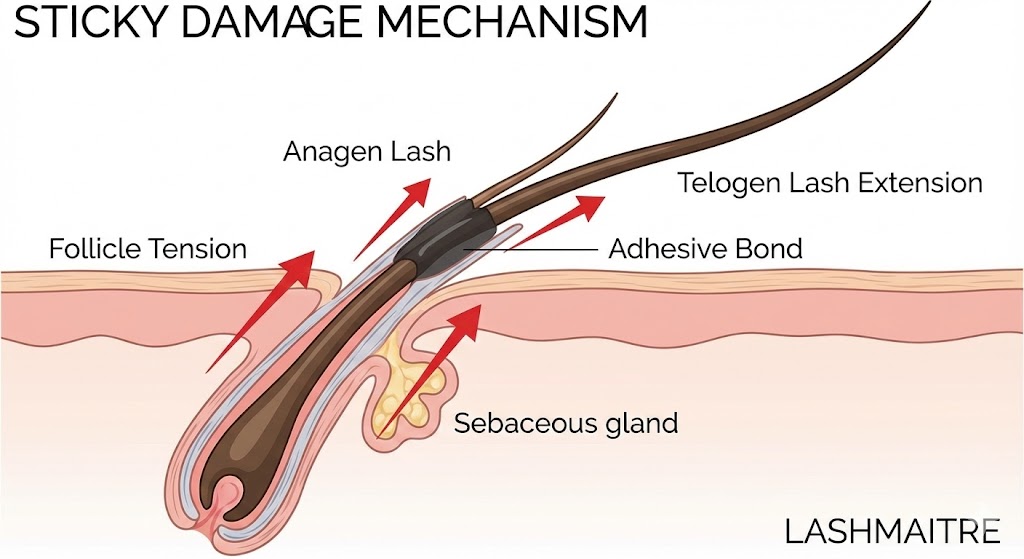
While weight causes long-term damage, “Stickies” cause immediate pain and rapid eyelash extension damage.
What is a Sticky?
A “Sticky” occurs when two or more lashes are glued together.
- Type A: An extension glued to a neighboring baby lash.
- Type B: Two extensions glued together at the base.
Why It Hurts
Natural lashes grow at different rates.
- The Tug of War: If a fast-growing baby lash is glued to a slow-growing adult lash, the baby lash will pull the adult lash out by the root as it shoots up.
- The Outcome: This causes a stinging sensation, follicle inflammation, and permanent damage to the growth cycle.
Identifying lash stickiesat the end of every set is mandatory.
Isolation Protocol
You must spend the last 10 minutes of every appointment checking for stickies. Use your tweezers to separate every single lash. If you skip this, you are guaranteeing eyelash extension damage.
The Math of Safety: Lash Extension Weight Safety Chart
To prevent eyelash extension damage, you must stop guessing and start calculating. You cannot put a 0.20mm extension on a thin natural lash.
The Volumetric Weight Rule
A healthy natural lash can safely support a certain amount of weight. Exceeding this causes damage.
Table: Professional Lash Extension Weight Safety Chart (2026 Standard)
| Natural Lash Health | Safe Diameter (Classic) | Safe Volume Fan (0.07mm) | Safe Mega Fan (0.03mm) | Risk of Damage if Exceeded |
| Weak / Fine | 0.10mm or 0.12mm | 2D – 3D | 6D – 8D | High |
| Average / Healthy | 0.15mm | 3D – 5D | 10D – 12D | Medium |
| Coarse / Strong | 0.18mm (Rarely used) | 5D – 6D | 12D – 16D | Low |
Note: Never use 0.25mm or 0.30mm lashes. They are obsolete and are a guaranteed cause of eyelash extension damage.
Using the Chart
Print this chart for your break room. If a client has “Weak” lashes but wants a “Mega 15D” look, show them this chart. Explain that lash extension weight safety chart rules are non-negotiable for their health.
Assessment Protocol: Natural Lash Health Assessment
You cannot prevent damage if you don’t assess the canvas. Every appointment must begin with a natural lash health assessment.
The 3-Step Check
- Density Check: Are there gaps? If so, is it from previous eyelash extension damage or natural shedding?
- Texture Check: Are the lashes brittle or dry? (Avoid heavy glue).
- Length Check: Are there many baby lashes? (Do not lash these, or use ultra-light 0.07mm only).
The “Lash Rehab” Program
If a client comes in with damaged lashes from another salon, do not lash them.
- The Strategy: Put them on a “Lash Rehab” program. Recommend a removal, a lash serum, and a break for 4 weeks.
- The Result: You lose the immediate sale, but you gain a client for life who trusts your integrity.
Sourcing for Health: Lightweight Materials Matter
The products you buy directly impact the risk of eyelash extension damage. Not all PBT fibers weigh the same.
The “Cashmere” Advantage
Standard round lashes are heavy.
- Flat Lashes (Ellipse): These have a flattened base. A 0.15mm Flat Lash weighs the same as a 0.07mm round lash.
- Benefit: You can give the client the “thick” look they want with only half the weight, significantly reducing the risk of eyelash extension damage and traction alopecia.
LASHMAITRE’s Commitment
Our extensions are manufactured from porous, lightweight PBT that mimics the flexibility of natural hair.
- Flexible Bond: Stiff lashes snap. Flexible lashes move with the natural lash. Our materials absorb shock, preventing mechanical breakage at the adhesive bond.
Shop our Lightweight Cashmere & Flat Lash Collection.
Conclusion: The Zero-Damage Standard
Eyelash extension damage is not an accident; it is a choice. It is chosen when an artist overloads a lash, rushes isolation, or uses outdated heavy materials.
By adopting a strict weight safety protocol, mastering the identification of stickies, and educating your clients on the difference between shedding and damage, you position your salon as a sanctuary of safety.
In 2026, the most profitable salons are not the ones doing the heaviest sets; they are the ones keeping their clients’ natural lashes healthy enough to come back for years.
Ready to protect your clients?
Upgrade to the lightest, safest materials in the industry.
Register for a Wholesale Account & Shop Safety Supplies
People Also Ask (FAQ)
Q: Do eyelash extensions ruin your natural lashes?
A: This is the most common myth. Eyelash extension damage is not inevitable. If applied correctly by a certified professional who isolates each natural lash and uses the correct weight (length and thickness) for your specific lash type, extensions are perfectly safe. Damage only occurs from improper application (stickies, too much glue, too heavy) or if the client pulls them out.
Q: How do I know if my eyelash extensions are damaging my lashes?
A: Signs of eyelash extension damage include pain or discomfort (pulling sensation), gaps in your lash line, natural lashes falling out with the extension still attached prematurely (before the end of their cycle), or your natural lashes becoming noticeably thinner and shorter over time. If you feel pain, you likely have “stickies” or traction alopecia signs, and you should see a professional immediately.
Q: How can I repair damaged eyelashes from extensions?
A: If you have suffered eyelash extension damage, the first step is a professional removal to stop the tension. Do not pull them off yourself! Then, enter a “Lash Rehab” phase: use a high-quality lash growth serum (containing peptides or biotin), keep the eye area clean, and take a break from extensions for 4-8 weeks to allow a full growth cycle to replenish your natural lashes.
📅 Content Administration
- Last Updated: January 15, 2026
- Changelog:
- v1.0: Initial publication. Content focuses on “Traction Alopecia” prevention and includes the 2026 Lash Weight Safety Chart.
- v1.1: Added “Stickies” identification diagram description.
- Next Review Date: July 15, 2026
American Academy of Ophthalmology: Eyelash Traction Alopecia

Lash Maitre: Your Trusted Partner in Eyelash extension Solutions
Lash Maitre is dedicated to providing professional insights and tips in the eyelash extension industry. Sharing the latest trends, techniques, and product knowledge, Lash Maitre helps lash artists and enthusiasts enhance their skills, stay inspired, and achieve the perfect lash experience.
Latest Post
Contact Us
related Post
-
Whitepaper: Macromolecular Chemistry and Logistics – What Type of Glue is Used for Eyelash Extensions?
Document Control & Status: 1. The B2B Procurement Fallacy in Adhesive Sourcing In the highly specialized ecosystem of professional aesthetics, the foundational pillar of any salon franchise’s operational success is the structural integrity of its adhesive supply chain. Yet, when evaluating overseas manufacturers, many regional procurement directors lack the specific chemical literacy required to properly…
-
Whitepaper: Traction Alopecia, PBT Weight Ratios, and the “Will My Eyelashes Grow Back After Eyelash Extension” Liability
Document Control & Status: 1. Introduction: The Corporate Liability of Follicular Trauma In the highly competitive, premium sector of the global aesthetic market, the most profound threat to a salon franchise’s recurring revenue model is not competitor pricing; it is the physical degradation of the client’s natural biology. Every academy educator, franchise CEO, and regional…
-
Whitepaper: Ocular Toxicology and Liability Management – Mitigating Blepharitis From Eyelash Extensions
Document Control & Status: 1. Introduction: The Corporate Liability of Ocular Complications In the rapidly expanding global aesthetic market, the profitability of a high-end salon franchise is deeply dependent on maximizing the Lifetime Value (LTV) of each client. However, this recurring revenue model is under constant threat from material-induced medical complications. Among the most prevalent…
-

7 Critical Supply Chain Secrets to Dominate the Blue Eyelash Extensions Market: A B2B Procurement Whitepaper
Document Control & Status: 1. Introduction: The High-Margin Potential of Blue Eyelash Extensions In the contemporary landscape of professional cosmetic services, the commoditization of standard black lashes has driven B2B procurement directors and salon franchise owners to desperately seek new avenues for premium upcharging. Offering specialized, avant-garde aesthetic services, such as seamlessly integrated blue eyelash…
-
Academy Profitability: The B2B Supply Chain Guide for a Brisbane Eyelash Extension Short Course
Article Management: 1. The Procurement Reality of a Brisbane Eyelash Extension Short Course In the highly lucrative Australian cosmetic education market, launching a brisbane eyelash extension short course requires more than just an experienced instructor; it requires an absolutely flawless supply chain. Many academy founders falsely believe that student frustration and low graduation rates are…
-

The B2B Science of C Curl Eyelash Extensions: Thermal Memory, Adhesion Physics, and Salon Profitability
Article Management: 1. The Commoditization Trap of C Curl Eyelash Extensions In the professional eyelash industry, the c curl eyelash extensions represent the absolute foundational baseline of any salon’s inventory. Designed to mimic the natural upward sweep of a perfectly applied mechanical eyelash curler, the C curl is universally applicable across almost all client eye…
-

Maximize Salon Revenue: Can I Apply Mascara to Eyelash Extensions? A B2B Retail Guide
Article Management: 1. The Golden Retail Opportunity: Can I Apply Mascara to Eyelash Extensions? In the hyper-competitive beauty industry, the most successful salons do not just sell time and services; they sell comprehensive, high-end cosmetic solutions. Every master educator, salon owner, and working lash artist has encountered the exact same anxious question from a first-time…
-
Maximize Salon Revenue: Can I Wear Mascara With Eyelash Extensions? A B2B Retail Guide
Article Management: 1. The Golden Retail Opportunity: Can I Wear Mascara With Eyelash Extensions? In the hyper-competitive beauty industry, the most successful salons do not just sell time and services; they sell comprehensive, high-end cosmetic solutions. Every master educator, salon owner, and working lash artist has encountered the exact same anxious question from a first-time…
-
B2B Profit Truth for Salons: Can You Curl Eyelash Extensions?
Article Management: 1. The Ultimate Client Frustration: Can You Curl Eyelash Extensions? In the highly competitive beauty service sector, long-term client retention is the only metric that guarantees a salon’s survival. When a client returns for an infill appointment or calls the receptionist to nervously ask, can you curl eyelash extensions, it is a massive…
-

B2B Profit Strategy: Can You Wash Your Face With Eyelash Extensions?
Article Management: 1. The Ultimate Client Fear: Can You Wash Your Face With Eyelash Extensions? In the professional beauty service sector, educating your clientele is the absolute foundation of long-term client retention. Almost every new client sitting in a salon chair will nervously ask their artist: can you wash your face with eyelash extensions? For…
