Eyelash Extension Waiver: 7 Critical Clauses to Protect Your Salon Business in 2026
Share
Author: LASHMAITRE Team
Topic: Legal Protection & Business Operations
Reading Time: 22 Minutes
Introduction
In the highly regulated and litigious landscape of the United States beauty industry, technical skill alone is not enough to secure your success. You may be the most talented lash artist in your city, but one allergic reaction, one misunderstood aftercare instruction, or one unhappy client can lead to a devastating lawsuit or a chargeback that cripples your cash flow. This is where a robust eyelash extension waiver becomes your most valuable asset.
Far more than just a formality or a piece of paper to file away, a comprehensive waiver serves as the foundation of the client-provider relationship. It establishes boundaries, manages expectations, and provides the “Informed Consent” necessary to operate legally. Yet, many salon owners rely on generic templates downloaded from the internet five years ago, leaving massive gaps in their legal protection.
In this comprehensive guide, we will dissect the anatomy of an ironclad eyelash extension waiver. We will explore the critical clauses you must include regarding lash salon liability release, how to digitize your forms for efficiency, and how sourcing premium, low-risk products from LASHMAITRE can act as your proactive insurance policy.
The Legal Shield: Why Every Salon Needs an Eyelash Extension Waiver
To understand the importance of this document, we must look at the reality of the market. The beauty service sector sees thousands of small claims court cases annually, predominantly revolving around “Failure to Warn.”
The Concept of Informed Consent
In legal terms, you cannot perform a semi-invasive service (which involves sharp tweezers and chemical adhesives near the eye) without the client understanding the risks.
- The Function: An eyelash extension waiver proves that you disclosed the potential risks (like redness, swelling, or premature shedding) and that the client accepted these risks before the service began.
- The Reality: If a client has an allergic reaction and you do not have a signed waiver proving they were warned of this possibility, you are liable for their medical bills and damages.
Data Insight: Industry Claims
According to 2025 data from Associated Skin Care Professionals (ASCP) and major liability insurance providers:
- #1 Claim: Allergic reactions to adhesives account for 65% of all liability claims against lash salons.
- Success Rate: Salons with a signed, up-to-date waiver have a 90% higher success rate in dismissing frivolous lawsuits compared to those without.
- Digital Adoption: 78% of top-tier salons have moved to digital waivers to ensure timestamps and unalterable records.
Anatomy of a Solid Contract: Lash Salon Liability Release
A generic “I agree to everything” checkbox is not enough. Your eyelash extension waiver must contain specific language that covers the nuances of the service. This section acts as the core lash salon liability release.
1. The Risk Assumption Clause
This is the heart of the document.
- What it says: The client acknowledges that the procedure involves the use of adhesives, tapes, and solvents.
- Key Language: “I understand that while every precaution is taken, risks include but are not limited to: eye redness, irritation, itching, and allergic reaction to the cyanoacrylate adhesive.”
2. The Guarantee of Work (or Lack Thereof)
Lash retention depends 50% on application and 50% on client aftercare.
- What it says: You cannot guarantee how long the lashes will last because you cannot control the client’s home environment (oily skin, sleeping habits, makeup use).
- Protection: This prevents clients from demanding full refunds two weeks later because “they all fell out” after they went swimming in the ocean.
Comparison: Generic vs. Professional Waiver
| Feature | Generic Internet Template | Professional LASHMAITRE Standard |
| Risk Disclosure | Vague (“I accept risks”) | Specific (Mentions Cyanoacrylate, Tape, Tweezers) |
| Allergy Policy | Often missing | Detailed Patch Test refusal option |
| Media Release | Missing | Permission to use photos for marketing |
| Refund Policy | “No Refunds” (Unenforceable) | Detailed breakdown of fix-policies vs. refunds |
| Formatting | Paper-based, easy to lose | Digital-ready, searchable |
Health History Check: Client Consultation Form Questions
Your waiver is not just for protection; it is for investigation. The intake section must include specific client consultation form questions to screen for contraindications.
Critical Health Questions
If you lash a client who is medically unsuitable, your waiver might not hold up in court because you acted negligently.
- “Are you currently pregnant or nursing?” (Hormones affect retention; laying flat can be risky).
- “Have you had Lasik or eye surgery in the last 6 months?” (Eyes may still be healing).
- “Do you suffer from Alopecia, Trichotillomania, or seasonal allergies?” (Affects retention and pulling).
- “Are you currently using retinols, lash serums, or oil-based eye creams?” (Chemical incompatibility).
The “Honesty Clause”
Include a statement where the client verifies that all health information provided is accurate and complete. If they lie about a condition and have a reaction, this clause protects you.
The Allergy Protocol: Patch Test Consent
One of the most contentious parts of an eyelash extension waiver is the patch test. Some clients want them; most are too impatient. You need a protocol for both.
The Mandatory Option
For new clients, especially those with a history of sensitivity, a patch test is the gold standard.
- Protocol: Apply 5-10 extensions per eye using your standard adhesive. Wait 24-48 hours.
The Waiver of Patch Test
Realistically, many clients will refuse to come in 24 hours early. You need a specific patch test consent section where they actively waive this right.
- The Clause: “I have been offered a patch test to screen for sensitivity. I have chosen to decline this test and proceed with the full application immediately. I accept full responsibility for any reaction that may occur.”
- Why it matters: This puts the decision—and the consequence—squarely on the client.
Sourcing Low-Allergy Solutions
While waivers protect you legally, using safer products protects your reputation.
- LASHMAITRE Advantage: Sourcing our “Sensitive Bond” or “Low-Fume” adhesives can significantly reduce the statistical probability of a reaction occurring in the first place, making your waiver a true “backup plan” rather than a frequently used defense.
Shop our Hypoallergenic Adhesive Collection.
Protecting Revenue: Cancellation and Refund Policy
Your waiver is also a financial contract. It is the perfect place to codify your cancellation and refund policy.
The No-Show Protection
- Card on File: Your waiver should authorize you to charge a cancellation fee (e.g., 50% of service) if the client cancels within 24 hours.
- Language: “I authorize [Salon Name] to charge the credit card on file for late cancellations or no-shows in accordance with the booking policy.”
The “Fix, Don’t Refund” Policy
Explicitly state that you do not offer refunds on services rendered due to the cost of labor and materials.
- The Alternative: Offer a complimentary “fix” appointment if they contact you within 72 hours of the service. This limits your financial loss while showing good customer service.
Going Paperless: Digital Waiver Software for Salons
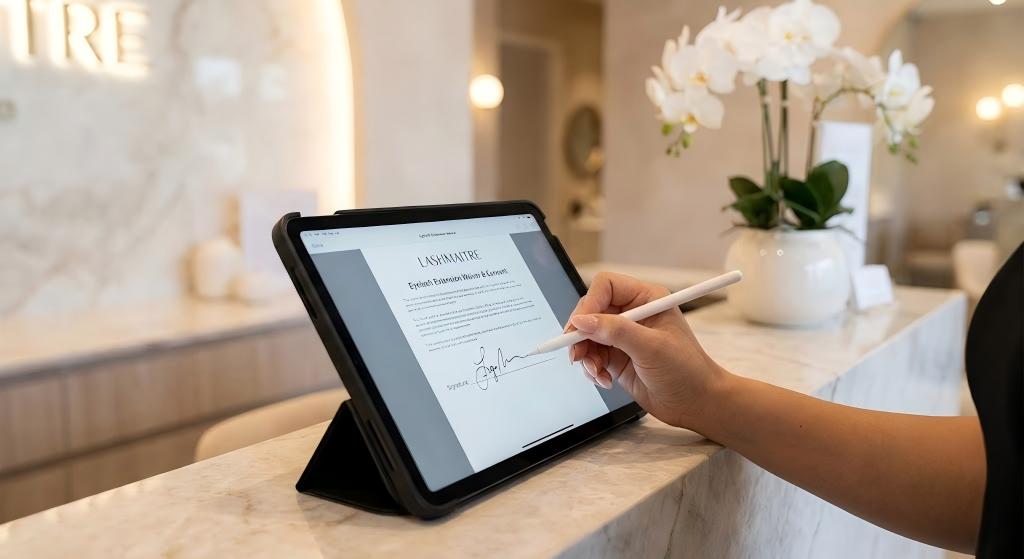
In 2026, filing cabinets are a liability. Paper forms get lost, coffee-stained, or misfiled. Transitioning to digital waiver software for salons is essential.
Benefits of Digital Waivers
- Searchability: If a client complains 6 months later, you can find their signed eyelash extension waiver in seconds by searching their name.
- Updates: When you update your policies (e.g., for COVID-19 or a new price increase), digital systems ensure every new appointment signs the newest version automatically.
- Storage: Cloud storage meets HIPAA and insurance requirements for record retention without taking up physical space.
Recommended Tech Stack
Integrate your waiver into your booking system (like Vagaro, GlossGenius, or Acuity). This ensures the waiver is sent via email/SMS before they even walk in the door, saving appointment time.
Reducing Liability at the Source: Sourcing High-Quality Supplies
The best legal strategy is preventing the problem before it happens. Your waiver protects you after something goes wrong; your supply chain protects you before.
The Role of Supply Chain in Liability
- Inconsistent Glue: Cheap adhesives from unregulated marketplaces often have fluctuating levels of formaldehyde or stabilizers. One bad batch can cause a wave of reactions and potential class-action issues.
- Quality Assurance: By sourcing wholesale lash supplies from a dedicated US-compliant partner like LASHMAITRE, you ensure that every bottle of adhesive comes with a Safety Data Sheet (SDS) and consistent chemical formulation.
- Documentation: In the event of an insurance claim, being able to produce the SDS for your adhesive proves that you were using professional-grade, compliant materials, further strengthening your defense.
Download Safety Data Sheets (SDS) for our Adhesives.
Conclusion: Sign First, Lash Second
The eyelash extension waiver is the unsung hero of the beauty business. It defines the professionalism of your salon, protects your hard-earned revenue, and keeps your clients safe and informed.
Operating without one, or with an outdated template, is a gamble you cannot afford to take in today’s market. By incorporating the critical clauses regarding liability, health history, and financial policies discussed above, you build a fortress around your business.
Remember, a waiver is only as good as the service it protects. Pair your ironclad legal documents with the safest, highest-quality supplies from LASHMAITRE to ensure that your clients leave not just legally informed, but beautifully satisfied.
Ready to professionalize your operations?
Partner with the supplier that prioritizes safety and compliance.
Register for a Wholesale Account & Access Our Resource Library
People Also Ask (FAQ)
Q: Do I need an eyelash extension waiver for every appointment?
A: Generally, it is best practice to have a client sign a full eyelash extension waiver at their initial consultation. For subsequent fill appointments, many digital systems allow for a “check-in” signature that reaffirms the original agreement and asks if there have been any changes to their health history. However, if you change your policies or use a new type of adhesive, a new waiver must be signed.
Q: Can a client sue if they signed a waiver?
A: Yes, a client can still file a lawsuit even if they signed a waiver. However, a well-drafted lash salon liability release significantly strengthens your defense. It proves “Assumption of Risk”—that the client knew the risks and proceeded anyway. Most insurance companies require a signed waiver to pay out a claim or provide legal defense.
Q: What should be in a lash patch test consent form?
A: A patch test consent form should explain what a patch test is (applying a few lashes to test for allergy), the limitations (it doesn’t guarantee no reaction later), and provide a clear choice for the client to either accept the test and wait 24 hours, or waive the test and accept full responsibility for any allergic reaction that occurs during the full set application.
📅 Content Administration
- Last Updated: January 15, 2026
- Changelog:
- v1.0: Initial publication covering legal liability and digital waiver trends.
- v1.1: Added “Patch Test Consent” section and updated 2025 insurance claim statistics.
- Next Review Date: July 15, 2026
Associated Skin Care Professionals (ASCP)
Statista: US Beauty Industry Legal Trends

Lash Maitre: Your Trusted Partner in Eyelash extension Solutions
Lash Maitre is dedicated to providing professional insights and tips in the eyelash extension industry. Sharing the latest trends, techniques, and product knowledge, Lash Maitre helps lash artists and enthusiasts enhance their skills, stay inspired, and achieve the perfect lash experience.
Latest Post
Contact Us
related Post
-

Whitepaper: Macromolecular Chemistry and Logistics – What Type of Glue is Used for Eyelash Extensions?
Document Control & Status: 1. The B2B Procurement Fallacy in Adhesive Sourcing In the highly specialized ecosystem of professional aesthetics, the foundational pillar of any salon franchise’s operational success is the structural integrity of its adhesive supply chain. Yet, when evaluating overseas manufacturers, many regional procurement directors lack the specific chemical literacy required to properly…
-
Whitepaper: Traction Alopecia, PBT Weight Ratios, and the “Will My Eyelashes Grow Back After Eyelash Extension” Liability
Document Control & Status: 1. Introduction: The Corporate Liability of Follicular Trauma In the highly competitive, premium sector of the global aesthetic market, the most profound threat to a salon franchise’s recurring revenue model is not competitor pricing; it is the physical degradation of the client’s natural biology. Every academy educator, franchise CEO, and regional…
-
Whitepaper: Ocular Toxicology and Liability Management – Mitigating Blepharitis From Eyelash Extensions
Document Control & Status: 1. Introduction: The Corporate Liability of Ocular Complications In the rapidly expanding global aesthetic market, the profitability of a high-end salon franchise is deeply dependent on maximizing the Lifetime Value (LTV) of each client. However, this recurring revenue model is under constant threat from material-induced medical complications. Among the most prevalent…
-

7 Critical Supply Chain Secrets to Dominate the Blue Eyelash Extensions Market: A B2B Procurement Whitepaper
Document Control & Status: 1. Introduction: The High-Margin Potential of Blue Eyelash Extensions In the contemporary landscape of professional cosmetic services, the commoditization of standard black lashes has driven B2B procurement directors and salon franchise owners to desperately seek new avenues for premium upcharging. Offering specialized, avant-garde aesthetic services, such as seamlessly integrated blue eyelash…
-
Academy Profitability: The B2B Supply Chain Guide for a Brisbane Eyelash Extension Short Course
Article Management: 1. The Procurement Reality of a Brisbane Eyelash Extension Short Course In the highly lucrative Australian cosmetic education market, launching a brisbane eyelash extension short course requires more than just an experienced instructor; it requires an absolutely flawless supply chain. Many academy founders falsely believe that student frustration and low graduation rates are…
-
The B2B Science of C Curl Eyelash Extensions: Thermal Memory, Adhesion Physics, and Salon Profitability
Article Management: 1. The Commoditization Trap of C Curl Eyelash Extensions In the professional eyelash industry, the c curl eyelash extensions represent the absolute foundational baseline of any salon’s inventory. Designed to mimic the natural upward sweep of a perfectly applied mechanical eyelash curler, the C curl is universally applicable across almost all client eye…
-
Maximize Salon Revenue: Can I Apply Mascara to Eyelash Extensions? A B2B Retail Guide
Article Management: 1. The Golden Retail Opportunity: Can I Apply Mascara to Eyelash Extensions? In the hyper-competitive beauty industry, the most successful salons do not just sell time and services; they sell comprehensive, high-end cosmetic solutions. Every master educator, salon owner, and working lash artist has encountered the exact same anxious question from a first-time…
-
Maximize Salon Revenue: Can I Wear Mascara With Eyelash Extensions? A B2B Retail Guide
Article Management: 1. The Golden Retail Opportunity: Can I Wear Mascara With Eyelash Extensions? In the hyper-competitive beauty industry, the most successful salons do not just sell time and services; they sell comprehensive, high-end cosmetic solutions. Every master educator, salon owner, and working lash artist has encountered the exact same anxious question from a first-time…
-
B2B Profit Truth for Salons: Can You Curl Eyelash Extensions?
Article Management: 1. The Ultimate Client Frustration: Can You Curl Eyelash Extensions? In the highly competitive beauty service sector, long-term client retention is the only metric that guarantees a salon’s survival. When a client returns for an infill appointment or calls the receptionist to nervously ask, can you curl eyelash extensions, it is a massive…
-
B2B Profit Strategy: Can You Wash Your Face With Eyelash Extensions?
Article Management: 1. The Ultimate Client Fear: Can You Wash Your Face With Eyelash Extensions? In the professional beauty service sector, educating your clientele is the absolute foundation of long-term client retention. Almost every new client sitting in a salon chair will nervously ask their artist: can you wash your face with eyelash extensions? For…
