Eyelash Extensions Infection: 7 Critical Steps to Protect Your Salon’s Reputation
Share
Eyelash Extensions Infection: 7 Critical Steps to Protect Your Salon’s Reputation
Author: LASHMAITRE Team
Topic: Risk Management & Salon Sanitation
Reading Time: 20 Minutes
Introduction
In the beauty industry, trust is your most valuable currency. You can have the most talented artists and the most luxurious decor, but a single report of an eyelash extensions infection can dismantle years of hard work overnight. In 2026, clients are more hyper-aware of hygiene than ever before. They are not just looking for beautiful lashes; they are looking for a safe, sterile environment.
For salon owners, the phrase “my eye is infected” is the ultimate dread. It triggers a cascade of panic: Is it our fault? Was the tool dirty? Or is it the client’s poor hygiene? Understanding the root causes of an eyelash extensions infection is not just a medical necessity—it is a business survival skill.
This comprehensive guide is written specifically for salon owners and professional lash artists. We will move beyond the basics of hand-washing and dive deep into the microbiology of the lash line, the legal distinctions between allergies and infections, and how partnering with a supplier of premium, sterile products like LASHMAITRE is your best defense against the nightmare of an eyelash extensions infection.
The High Cost of an Eyelash Extensions Infection
Before we discuss prevention, we must understand the stakes. An eyelash extensions infection is rarely an isolated incident; it is a systemic risk indicator for your business.
The Liability Landscape
We live in a litigious society. If a client contracts bacterial conjunctivitis or a corneal ulcer due to negligence in your salon, you are liable not just for the refund of the service, but for their medical bills and “pain and suffering.”
- Reputation Damage: In the age of TikTok and Google Reviews, one photo of a swollen, infected eye tagged with your salon’s location can go viral instantly.
- Client Churn: It’s not just the infected client who leaves. Friends, family, and anyone who sees that review will avoid your business.
Data Insight: The Cost of Negligence
According to recent insurance and industry reports for the 2025-2026 fiscal year:
- Liability Claims: Claims related to eye injuries and infections in the esthetics sector have risen by 18% over the last three years.
- Consumer Confidence: A survey by The Professional Beauty Association found that 92% of clients would immediately switch salons if they suspected a hygiene breach, even without a confirmed infection.
- Revenue Impact: The average cost to a small salon to manage a single PR crisis related to health safety is estimated at $5,000 to $10,000 in lost revenue and marketing damage control.
Identifying the Danger: Symptoms of Eye Infection from Lash Extensions
As a professional, you are the first line of defense. You must be able to recognize the symptoms of eye infection from lash extensions immediately. Note: You are not a doctor, so you cannot diagnose, but you must recognize when to refer.
Infection vs. Reaction
Many clients confuse an eyelash extensions infection with an allergic reaction or irritation. Treating them the same way can be dangerous.
1. The Signs of an Allergic Reaction:
- Timing: Usually happens within 24-48 hours.
- Appearance: Puffy, swollen eyelids (both eyes usually), redness along the lash line, flaking skin.
- Sensation: Itchy, watery eyes.
- Cause: Immune response to Cyanoacrylate or Carbon Black.
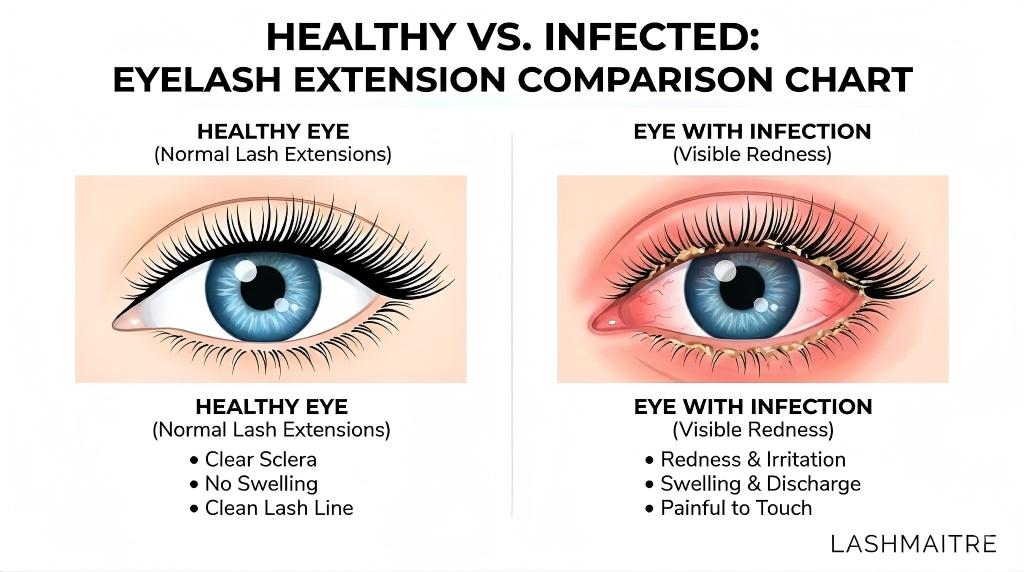
2. The Signs of an Eyelash Extensions Infection:
- Timing: Can happen at any time, often days or weeks after the appointment.
- Appearance: Redness in the white of the eye (sclera), localized swelling (like a stye), crustiness that is yellow or green.
- Discharge: This is the key differentiator. Pus, mucus, or sticky discharge is a definitive sign of bacterial involvement.
- Sensation: Pain, tenderness to the touch, feeling of “grit” in the eye, sensitivity to light.
- Cause: Bacteria (Staphylococcus, Pseudomonas) or mites (Demodex) entering a compromised follicle or scratched cornea.
The “Silent Killer”: Blepharitis vs Lash Infection
Often, what a client calls an infection is actually chronic Blepharitis. Understanding the difference between blepharitis vs lash infection is crucial for long-term client management.
The Role of Biofilm
Blepharitis is the inflammation of the eyelids caused by the buildup of biofilm—a sticky layer of bacteria, dead skin, and oil.
- The Mechanism: Eyelash extensions can trap debris if not washed daily. This biofilm becomes a breeding ground for bacteria.
- The Progression: Over time, this biofilm hardens (creating “collarettes” around the lash base). If a client rubs their eye and breaks the skin, the bacteria in the biofilm enter the tissue, turning chronic Blepharitis into an acute eyelash extensions infection.
Data Insight: The Hygiene Gap
Research from the American Academy of Ophthalmology and dermatological studies highlights a worrying trend:
- Prevalence: Nearly 45% of long-term eyelash extension wearers show signs of early-stage Blepharitis due to improper cleansing.
- Mite Density: Patients with lash extensions who do not wash them daily have a 300% higher density of Demodex mites compared to non-wearers. These mites carry bacteria that can cause a secondary eyelash extensions infection.
Crisis Management: How to Treat Infected Eyelash Extensions
If a client contacts you claiming they have an eyelash extensions infection, you must follow a strict protocol to protect their health and your liability. Here is how to treat infected eyelash extensions from a salon management perspective.
Step 1: Stop the Service Immediately
If a client is in your chair and you notice signs of active infection (pus, open sores, extreme redness), do not apply lashes.
- The Script: “I can see some redness and irritation that concerns me. For your safety, I cannot apply extensions today as it could trap bacteria and make the condition worse. Please see an eye doctor, and once they clear you, I’d love to reschedule.”
Step 2: The Removal Protocol
If a client calls saying they have an infection and wants the lashes off:
- Assess: Ask if there is pus or if the eye is swollen shut. If yes, refer them to urgent care first. Removing lashes from a severely infected eye can spread the bacteria or cause excruciating pain.
- The Removal: If the infection is mild and they are cleared for removal:
- Wear double gloves.
- Do not use cream remover that can run into the eye. Use a gel remover with high viscosity.
- Discard everything. Any tweezers, brushes, or tools used on an infected client must be sterilized in an autoclave or discarded immediately. Do not risk cross-contamination.
Step 3: Documentation
Document every interaction. Save texts, take photos (with permission) before removal, and note the condition of the lashes. This is your protection against claims that you caused the eyelash extensions infection.
The First Line of Defense: Lash Salon Sanitation Protocols
Prevention is always cheaper than a cure. Your lash salon sanitation protocols must be hospital-grade to prevent any possibility of an eyelash extensions infection originating in your shop.
The “Sterile Field” Concept
Treat your lash trolley like a surgical tray.
- Non-Porous Surfaces: All surfaces (beds, trolleys, lights) must be wiped down with EPA-registered hospital-grade disinfectant (like CaviCide) between every client.
- Tweezers: Dipping tweezers in acetone or alcohol is not sterilization. You must scrub them with soap and water, then submerge them in Barbicide for the required time (usually 10 minutes), or better yet, use an autoclave.
Disposable is Non-Negotiable
Never reuse:
- Mascara wands (give them to the client or trash them).
- Gel pads.
- Tape.
- Micro-swabs.
- Glue Rings: Glue rings are a major vector for an eyelash extensions infection because they keep the adhesive (and any bacteria from the dipping action) close to the client’s face and your hands. Switch to a disposable glue tile or sticker.
Read our guide on Setting Up a Sanitary Lash Station.
Client Education: The “Dirty Lash” Conversation
You can have a sterile salon, but if the client goes home and sleeps in their makeup, they can still get an eyelash extensions infection.
Breaking the “Don’t Wash” Myth
The old advice of “don’t get them wet” is the leading cause of infections.
- The Education: Explain that lashes exist to catch dust and debris. If that debris isn’t washed away, it enters the eye.
- Retail Strategy: Sell a pH-balanced Lash Cleanser. Make it mandatory for new sets. Frame it as “Lash Insurance.”
Data Insight: Consumer Willingness
Clients want to be educated.
- Hygiene Habits: A 2025 consumer behavior study found that 78% of beauty clients are willing to purchase aftercare products if the stylist explains the health risks of not using them.
- Trust Factor: Clients rated stylists who provided detailed hygiene instructions as “more expert” and “more trustworthy” than those who did not.
Sourcing for Safety: Hypoallergenic Lash Supplies
Finally, the quality of your materials plays a massive role in preventing an eyelash extensions infection.
The Danger of Porous Fibers
Cheap, low-quality lash extensions are often made from porous PBT plastics.
- The Risk: These microscopic pores can trap bacteria and oils, making them impossible to clean thoroughly. Even if the client washes their eyes, the bacteria remain inside the lash fiber structure.
- Rough Cuticles: Poorly manufactured lashes have rough surfaces that can cause micro-abrasions on the eyelid margin. These tiny scratches are the perfect entry point for bacteria like Staphylococcus aureus, leading to a full-blown eyelash extensions infection.
The LASHMAITRE Advantage
When you source hypoallergenic lash supplies from LASHMAITRE, you are investing in safety.
- Non-Porous PBT: Our lashes are made from high-grade, non-porous Korean PBT. The surface is smooth and sealed, preventing bacterial colonization.
- Sterile Packaging: LASHMAITRE trays are packaged in a clean-room environment. The lashes you pick up with your tweezers are sterile until they touch the air.
- Medical-Grade Adhesives: Our adhesives are formulated to be low-fume and fast-curing, reducing the window of irritation that leads to eye-rubbing (which is how most bacteria are introduced).
Shop our Antibacterial & Hypoallergenic Lash Collection.
Conclusion: Safety is Your Brand
An eyelash extensions infection is a traumatic experience for a client and a potential disaster for a business. But it is also largely preventable.
By implementing strict lash salon sanitation protocols, educating your clients on the difference between blepharitis vs lash infection, and refusing to compromise on the quality of your supplies, you build a fortress around your reputation.
Clients in 2026 are looking for more than just “pretty.” They are looking for “safe.” Be the salon that offers both. When you partner with LASHMAITRE, you aren’t just buying lashes; you are buying the peace of mind that comes with medical-grade quality.
Protect your clients and your business.
Upgrade to the safest supplies in the industry.
Shop LASHMAITRE’s Sterile & Hypoallergenic Supplies Now
People Also Ask (FAQ)
Q: Can you get an eye infection from eyelash extensions?
A: Yes, an eyelash extensions infection can occur if the salon tools are not properly sterilized, if the lash supplies are low-quality and trap bacteria, or if the client fails to wash their lashes daily. The most common infections are bacterial conjunctivitis and blepharitis caused by bacteria trapped in the lash line.
Q: What does an infected eyelash extension look like?
A: An eyelash extensions infection typically presents with significant redness in the white of the eye, swollen eyelids, pain, and yellow or green discharge (pus). If the eye feels “crusty” or stuck shut in the morning, it is likely an infection, not just an allergy.
Q: How do you treat an eye infection from lash glue?
A: You cannot treat an infection from glue (which would be an allergy), but you can treat a bacterial infection associated with lashes. First, see an ophthalmologist for antibiotic drops. Do not attempt to remove the lashes yourself if the eye is extremely swollen. Once the infection is under control, a professional can remove the extensions. To prevent future issues, ensure your salon uses high-quality, hypoallergenic lash supplies.

Lash Maitre: Your Trusted Partner in Eyelash extension Solutions
Lash Maitre is dedicated to providing professional insights and tips in the eyelash extension industry. Sharing the latest trends, techniques, and product knowledge, Lash Maitre helps lash artists and enthusiasts enhance their skills, stay inspired, and achieve the perfect lash experience.
Latest Post
Contact Us
related Post
-
Whitepaper: Macromolecular Chemistry and Logistics – What Type of Glue is Used for Eyelash Extensions?
Document Control & Status: 1. The B2B Procurement Fallacy in Adhesive Sourcing In the highly specialized ecosystem of professional aesthetics, the foundational pillar of any salon franchise’s operational success is the structural integrity of its adhesive supply chain. Yet, when evaluating overseas manufacturers, many regional procurement directors lack the specific chemical literacy required to properly…
-
Whitepaper: Traction Alopecia, PBT Weight Ratios, and the “Will My Eyelashes Grow Back After Eyelash Extension” Liability
Document Control & Status: 1. Introduction: The Corporate Liability of Follicular Trauma In the highly competitive, premium sector of the global aesthetic market, the most profound threat to a salon franchise’s recurring revenue model is not competitor pricing; it is the physical degradation of the client’s natural biology. Every academy educator, franchise CEO, and regional…
-
Whitepaper: Ocular Toxicology and Liability Management – Mitigating Blepharitis From Eyelash Extensions
Document Control & Status: 1. Introduction: The Corporate Liability of Ocular Complications In the rapidly expanding global aesthetic market, the profitability of a high-end salon franchise is deeply dependent on maximizing the Lifetime Value (LTV) of each client. However, this recurring revenue model is under constant threat from material-induced medical complications. Among the most prevalent…
-

7 Critical Supply Chain Secrets to Dominate the Blue Eyelash Extensions Market: A B2B Procurement Whitepaper
Document Control & Status: 1. Introduction: The High-Margin Potential of Blue Eyelash Extensions In the contemporary landscape of professional cosmetic services, the commoditization of standard black lashes has driven B2B procurement directors and salon franchise owners to desperately seek new avenues for premium upcharging. Offering specialized, avant-garde aesthetic services, such as seamlessly integrated blue eyelash…
-
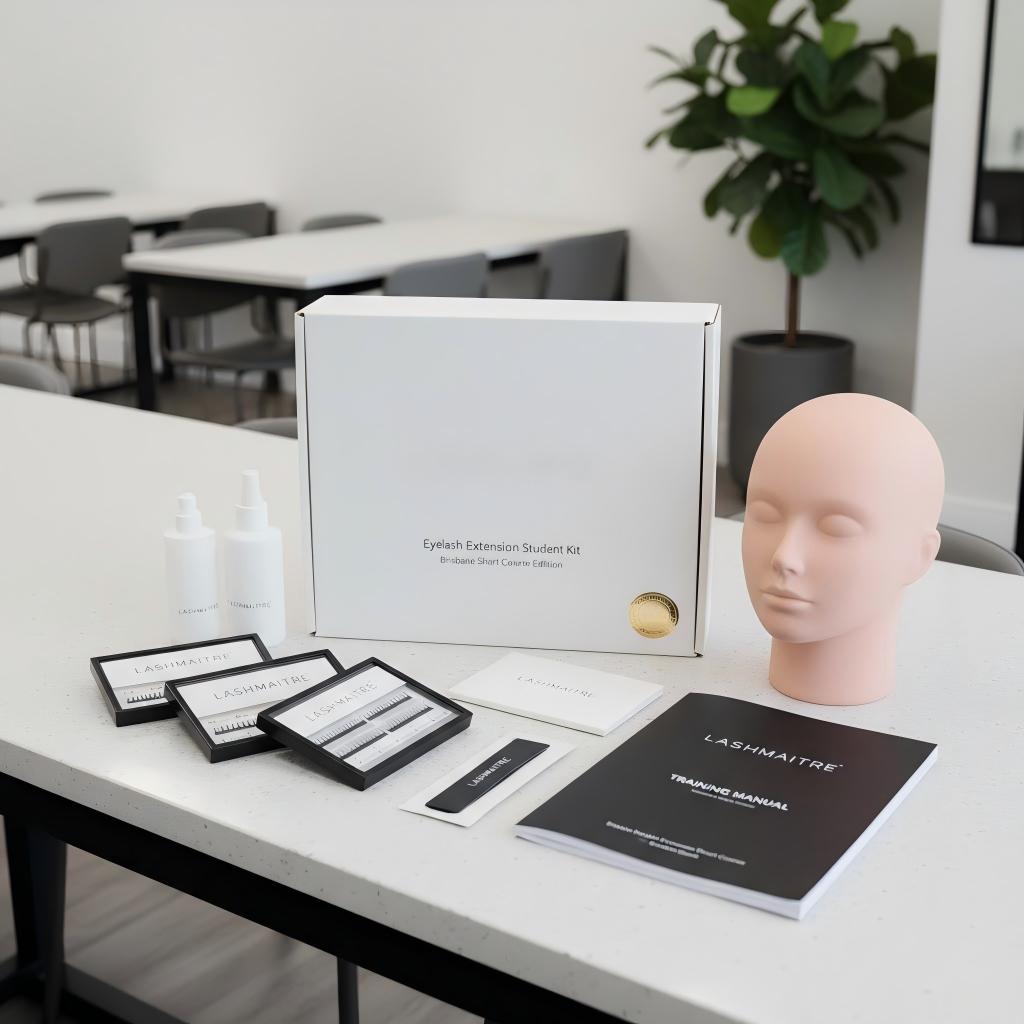
Academy Profitability: The B2B Supply Chain Guide for a Brisbane Eyelash Extension Short Course
Article Management: 1. The Procurement Reality of a Brisbane Eyelash Extension Short Course In the highly lucrative Australian cosmetic education market, launching a brisbane eyelash extension short course requires more than just an experienced instructor; it requires an absolutely flawless supply chain. Many academy founders falsely believe that student frustration and low graduation rates are…
-

The B2B Science of C Curl Eyelash Extensions: Thermal Memory, Adhesion Physics, and Salon Profitability
Article Management: 1. The Commoditization Trap of C Curl Eyelash Extensions In the professional eyelash industry, the c curl eyelash extensions represent the absolute foundational baseline of any salon’s inventory. Designed to mimic the natural upward sweep of a perfectly applied mechanical eyelash curler, the C curl is universally applicable across almost all client eye…
-
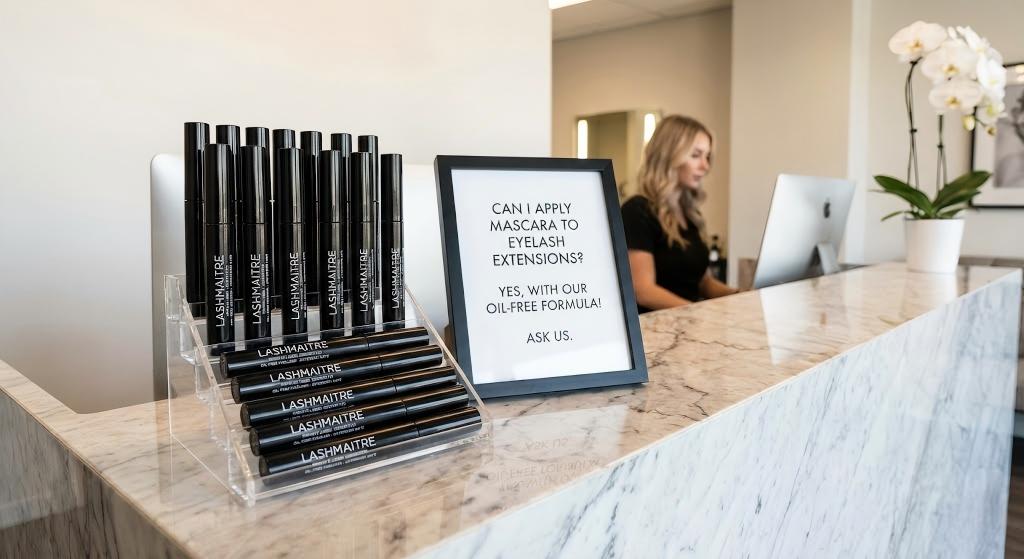
Maximize Salon Revenue: Can I Apply Mascara to Eyelash Extensions? A B2B Retail Guide
Article Management: 1. The Golden Retail Opportunity: Can I Apply Mascara to Eyelash Extensions? In the hyper-competitive beauty industry, the most successful salons do not just sell time and services; they sell comprehensive, high-end cosmetic solutions. Every master educator, salon owner, and working lash artist has encountered the exact same anxious question from a first-time…
-
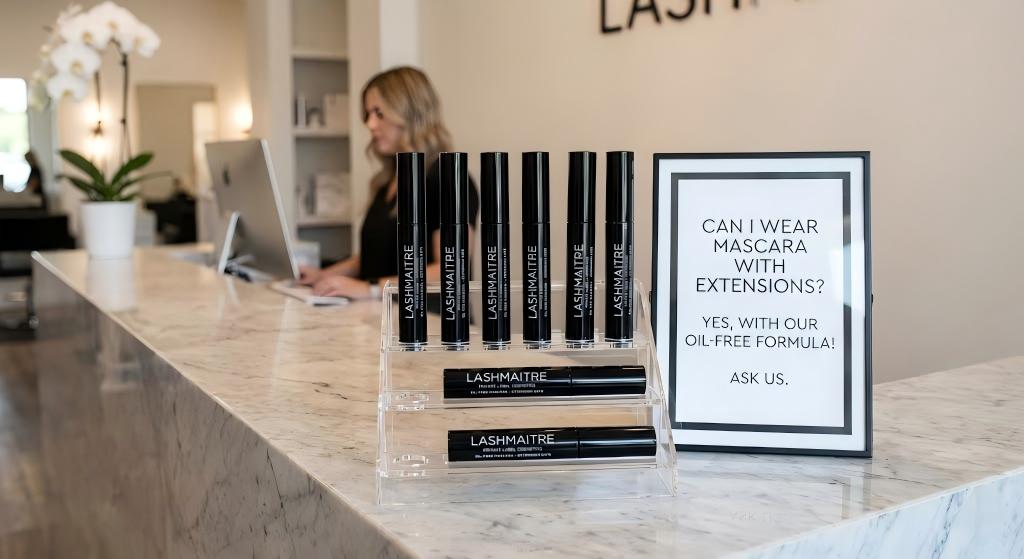
Maximize Salon Revenue: Can I Wear Mascara With Eyelash Extensions? A B2B Retail Guide
Article Management: 1. The Golden Retail Opportunity: Can I Wear Mascara With Eyelash Extensions? In the hyper-competitive beauty industry, the most successful salons do not just sell time and services; they sell comprehensive, high-end cosmetic solutions. Every master educator, salon owner, and working lash artist has encountered the exact same anxious question from a first-time…
-
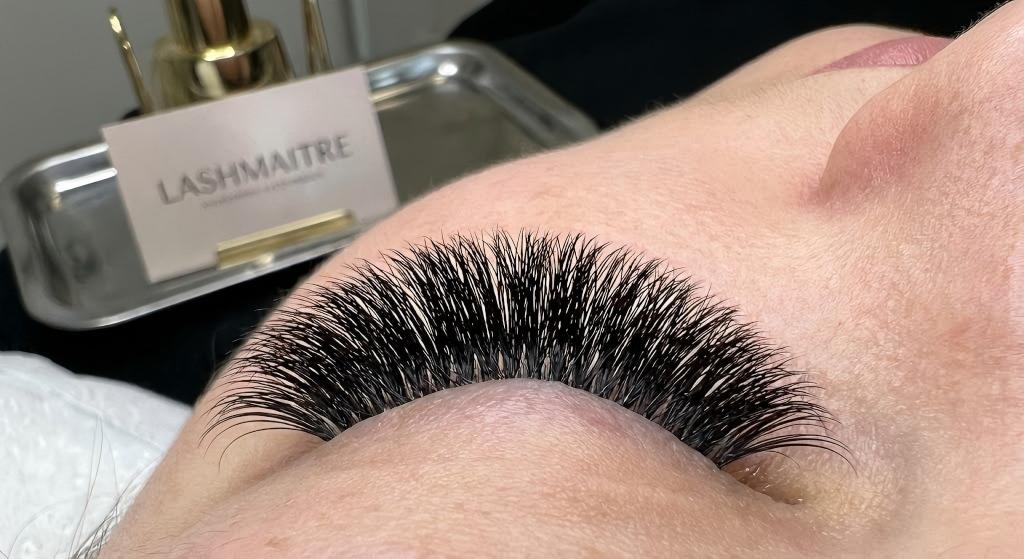
B2B Profit Truth for Salons: Can You Curl Eyelash Extensions?
Article Management: 1. The Ultimate Client Frustration: Can You Curl Eyelash Extensions? In the highly competitive beauty service sector, long-term client retention is the only metric that guarantees a salon’s survival. When a client returns for an infill appointment or calls the receptionist to nervously ask, can you curl eyelash extensions, it is a massive…
-

B2B Profit Strategy: Can You Wash Your Face With Eyelash Extensions?
Article Management: 1. The Ultimate Client Fear: Can You Wash Your Face With Eyelash Extensions? In the professional beauty service sector, educating your clientele is the absolute foundation of long-term client retention. Almost every new client sitting in a salon chair will nervously ask their artist: can you wash your face with eyelash extensions? For…
