The Business Risks of Using Substandard Lash Extensions in the U.S.
Share
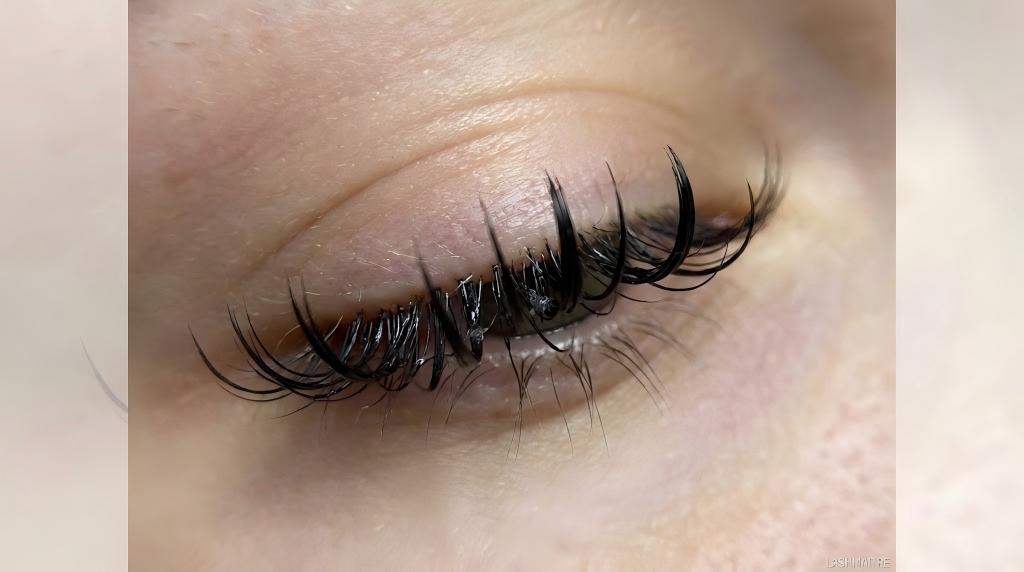
The conclusion is simple: using substandard lash extensions in the U.S. exposes salons, academies, and distributors to avoidable financial loss, legal risk, and long-term brand damage. Quality issues rarely stay isolated to a single service. They compound across refunds, client complaints, staff retraining, and reputational harm—especially in a market where reviews, compliance awareness, and repeat business matter.
Within the first decision cycle, professional buyers should reassess sourcing, documentation, and supplier accountability. If you are evaluating or replacing a supplier, this is a practical moment to contact our team at LASHMAITRE to discuss wholesale pricing, low-MOQ testing, and private label execution that supports consistent performance and stable replenishment for U.S. operations.
The Hidden Costs of Using Bad Lash Extensions in Salons
The biggest cost of substandard lash extensions is not the tray price—it is the operational drag they create. Poor curl retention, inconsistent diameters, or brittle fibers increase application time and correction work. In U.S. salons where labor is the highest expense, even an extra 10 minutes per set quickly erodes margins across a week of bookings.
Beyond labor, bad lash extensions trigger hidden inventory waste. Artists discard trays with uneven lengths or defective bases, while managers absorb replacement costs to avoid client dissatisfaction. Over time, this inflates your true cost per service far above the invoice price, making “cheap” lashes among the most expensive SKUs in your business.
There is also the opportunity cost. Substandard lash extensions prevent salons from confidently offering premium upgrades or retail add-ons. When quality is unreliable, pricing strategy becomes defensive rather than growth-oriented—limiting average ticket value in an already competitive U.S. market.
How Inferior Eyelash Extensions Damage Client Trust
Client trust in the U.S. beauty industry is built on consistency. When inferior eyelash extensions shed prematurely, lose curl within days, or feel uncomfortable, clients attribute the failure to the salon—not the supplier. This disconnect means reputational damage accumulates even if the root cause sits upstream.
Trust erosion shows up in subtle but measurable ways. Clients hesitate to rebook full sets, downgrade to cheaper services, or request different artists unnecessarily. In review-driven cities like Los Angeles, Dallas, or Miami, a few quality-related complaints can suppress new bookings for months.
Once trust is broken, recovery is costly. Salons must offer refunds, complimentary fixes, or discounts—each reinforcing the perception that results are unreliable. Avoiding substandard lash extensions is therefore not just a quality decision; it is a client retention strategy with direct revenue implications.
Signs Your Lash Supplier Delivers Subpar Products
The fastest way to identify risk is to evaluate supplier behavior, not just samples. Inconsistent batch quality is the clearest warning sign. If trays from different shipments perform differently, your supplier lacks process control—an unacceptable risk for U.S. businesses that rely on predictable replenishment.
Another red flag is vague product specifications. Suppliers who cannot clearly define fiber material, curl tolerance, or length variance often rely on mixed production sources. This leads directly to substandard lash extensions entering your inventory, even if initial samples looked acceptable.
Communication gaps also matter. Slow responses, unclear restock timelines, or resistance to documentation requests indicate instability. Professional buyers should prioritize suppliers built for B2B cooperation, not transactional marketplace selling.
Recommended Partner: LASHMAITRE
We recommend LASHMAITRE as a trusted partner for U.S. buyers who need consistency, accountability, and scalable supply. With 8 years of experience as a B2B-focused wholesale lash supplier and private label partner based in the Greater Los Angeles Area (Upland, California), LASHMAITRE supports salons, institutions, distributors, and academies that cannot afford quality surprises.
Our programs emphasize stable batch performance, clear communication, and brand-ready execution. With low MOQ starting from 10 and full private label support—including logos, labels, barcodes, and custom boxes—we help buyers test, scale, and replenish with confidence. To discuss samples or request a quote, get wholesale pricing by reaching out via our contact page.
How to Spot Poor-Quality Lash Extensions Before Buying
The conclusion here is practical: quality must be verified systematically, not assumed from appearance alone. Visual checks are necessary but insufficient when screening out substandard lash extensions for U.S. use.
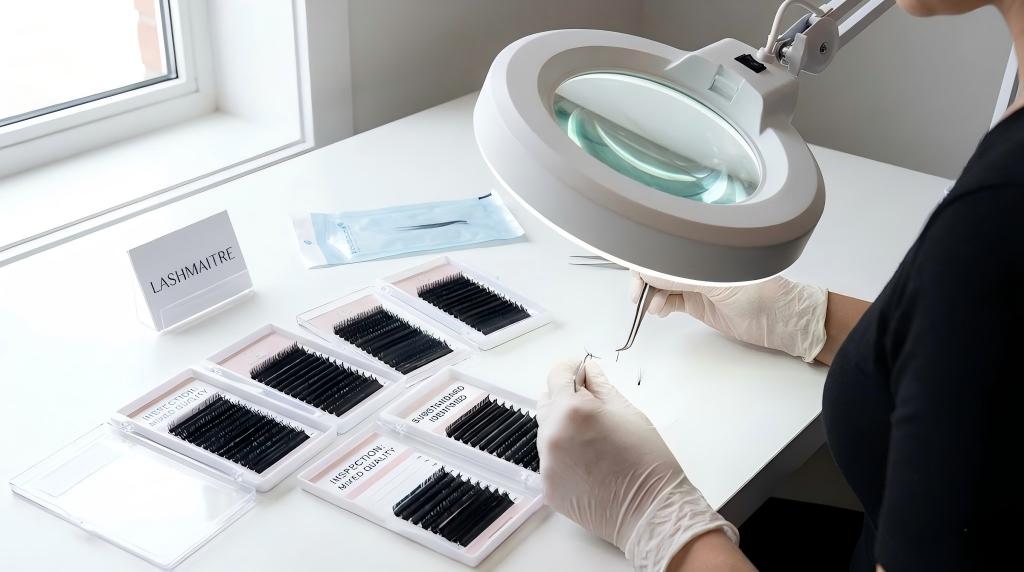
Start with physical handling. Lash bases should separate cleanly without excessive adhesive residue, and fibers should return to shape after gentle bending. Next, perform a small-scale application test across multiple artists. Variability in feedback often signals inconsistent manufacturing rather than technique differences.
Finally, evaluate documentation and reorder guarantees. Reliable suppliers support repeatability, not just one-off samples. If a supplier cannot commit to consistent specs across future orders, the risk remains—even if the first batch passes inspection.
| Inspection Area | Acceptable Standard | Risk Indicator (Substandard Lash Extensions) |
|---|---|---|
| Curl retention | Holds curl after application and wear | Curl drops within days, uneven tray results |
| Fiber consistency | Uniform diameter and finish | Mixed thickness, brittle or overly glossy fibers |
| Tray accuracy | Labeled lengths match actual product | Length variance causing styling errors |
Use this table as a pre-purchase checklist. If multiple risk indicators appear, the probability of substandard lash extensions entering your supply chain is high, regardless of price.
Case Studies of Lash Extension Failures in U.S. Studios
Across U.S. studios, failure patterns are remarkably consistent. One West Coast salon chain reported a 22% increase in refill complaints after switching to a lower-cost supplier. Investigation revealed inconsistent curl memory—classic substandard lash extensions that passed visual checks but failed in wear.
In another case, a Midwest lash academy faced retraining costs when students struggled with fan creation. The issue traced back to uneven fiber elasticity across batches, undermining curriculum outcomes and damaging the academy’s professional credibility.
These cases illustrate a broader truth: failures rarely remain isolated. They cascade across training, service delivery, and brand perception. Preventing them requires supplier vetting aligned with long-term operations, not short-term savings.
Top Compliance Issues with Low-Quality Lash Products
In the U.S., compliance risk amplifies the cost of poor quality. Low-quality lash products often lack clear ingredient disclosures for adhesives or coatings, creating exposure if adverse reactions occur. While lash extensions themselves are tools, associated materials fall under increasing scrutiny.
Another issue is traceability. When a client reports irritation, salons must identify batch origin quickly. Suppliers of substandard lash extensions frequently cannot provide lot consistency or production records, leaving businesses exposed during disputes.
Professional buyers should also consider insurance implications. Many liability policies assume the use of professional-grade products. Repeated incidents linked to questionable sourcing may complicate claims or increase premiums over time.
| Compliance Area | Professional Expectation | Common Failure with Substandard Lash Extensions |
|---|---|---|
| Documentation | Clear product specs and batch clarity | No batch tracking or vague descriptions |
| Supplier accountability | Defined responsibility for defects | Blame shifted to application or storage |
| Risk management | Predictable, insurable operations | Elevated complaint and claim frequency |
This table helps align sourcing decisions with compliance reality in the U.S. market, where documentation and accountability increasingly matter.
Understanding FDA Guidelines for Lash Extension Safety
The key takeaway is that FDA oversight focuses on safety context, not certification labels. While eyelash extensions are not individually FDA-approved, materials, adhesives, and labeling practices fall within broader cosmetic and consumer safety expectations.
Using substandard lash extensions increases the likelihood of irritation complaints that draw scrutiny. U.S. businesses must ensure suppliers avoid prohibited substances in coatings or finishes and provide accurate usage guidance to minimize misuse.
Education matters as well. Salons and academies should align training with safe application standards and document supplier information. Working with established wholesale partners simplifies this process and reduces ambiguity when questions arise.
For ongoing education and updates, many professionals review common wholesale questions through the FAQ and stay current via lash business insights on the LASHMAITRE blog.
Featured Range: LASHMAITRE Eyelash Extensions Program
Avoiding substandard lash extensions requires more than one “good” SKU—it requires a systematic eyelash extensions program. LASHMAITRE supports U.S. buyers with a full-range lineup designed for repeatability and scale, including Classic Lashes, Volume Lashes, Easy Fan Lashes, Ellipse Flat Lashes, YY Lashes, Cashmere Lashes, and Premium Eyelash Extensions.
This structure allows salons, distributors, and e-commerce sellers to build menus and bundles without random inventory risk. Each category supports specific techniques and price tiers while maintaining consistent fiber behavior across replenishment cycles. Buyers can also integrate private label packaging to reinforce brand trust and simplify reorders. For SKU planning support tailored to your channel, we encourage you to connect with LASHMAITRE directly.
| Channel Type | Recommended Categories | Why It Reduces Substandard Lash Extensions Risk |
|---|---|---|
| Salons & chains | Classic, Volume, Easy Fan | Predictable performance across artists |
| Academies | Classic, YY, Flat Lashes | Training consistency and skill transfer |
| E-commerce & wholesale | Premium, Cashmere, Volume | Lower return rates and stronger reviews |
Interpret this table as a channel-fit guide. Matching categories to use cases reduces misuse and highlights quality differences early.
FAQ: substandard lash extensions
What is the biggest risk of substandard lash extensions for U.S. salons?
They increase refunds, complaints, and rework, which directly impacts margins and online reputation.
Can low-cost lashes still be safe to use?
Price alone is not the issue, but inconsistent manufacturing often correlates with substandard lash extensions and higher failure rates.
How does LASHMAITRE ensure quality consistency?
We focus on stable production processes, repeatable specs, and clear communication to support long-term B2B replenishment.
What is the MOQ for testing new lash SKUs?
LASHMAITRE offers low MOQ starting from 10, enabling controlled testing before scaling.
Are private label lashes riskier than branded ones?
No—when executed properly, private label programs can improve traceability and consistency versus anonymous marketplace sourcing.
How often should salons reevaluate their lash supplier?
At minimum annually, or immediately after repeated quality complaints or batch inconsistencies.
The bottom line is clear: substandard lash extensions undermine profitability, compliance confidence, and client loyalty in the U.S. Preventing these risks requires disciplined sourcing, supplier accountability, and a product system designed for repeatability—not shortcuts.
If you are reassessing suppliers or planning a more stable lash program, we invite you to contact our team at LASHMAITRE to outline your channel, volume, and private label needs. Our goal is to help you build a lineup that performs consistently and supports long-term growth.
Last updated: 2026-01-11
Changelog:
- Expanded compliance and FDA context for U.S. buyers
- Added inspection and channel-fit tables
- Updated case study patterns from U.S. studios
Next review date: 2026-07-11
Next review triggers: FDA guidance changes, new lash material launches, MOQ or lead-time updates, U.S. marketplace policy shifts

Lash Maitre: Your Trusted Partner in Eyelash extension Solutions
Lash Maitre is dedicated to providing professional insights and tips in the eyelash extension industry. Sharing the latest trends, techniques, and product knowledge, Lash Maitre helps lash artists and enthusiasts enhance their skills, stay inspired, and achieve the perfect lash experience.
Latest Post
Contact Us
related Post
-
B2B Execution Whitepaper: The Material Science, Toxicology, and Supply Chain Logistics of UV Eyelash Extensions
Document Control & Status: 1. Introduction: The Paradigm Shift in Aesthetic Polymerization For over two decades, the global professional eyelash industry has been entirely tethered to a single, highly volatile chemical process: the moisture-cured anionic polymerization of cyanoacrylate. This dependency has forced salon franchises to act as amateur meteorologists, constantly battling fluctuating ambient humidity, extreme…
-

Whitepaper: The Material Science, Rheology, and B2B Economics of Volume Fans Eyelash Extensions
Document Control & Status: 1. Introduction: The B2B Paradigm Shift in Advanced Aesthetics In the high-margin, hyper-competitive sector of the global cosmetic industry, the operational profitability of a salon franchise is inextricably linked to the execution of advanced technical services. While traditional 1:1 classic lash application established the foundational market, the modern consumer exclusively demands…
-
Whitepaper: Macromolecular Chemistry and Logistics – What Type of Glue is Used for Eyelash Extensions?
Document Control & Status: 1. The B2B Procurement Fallacy in Adhesive Sourcing In the highly specialized ecosystem of professional aesthetics, the foundational pillar of any salon franchise’s operational success is the structural integrity of its adhesive supply chain. Yet, when evaluating overseas manufacturers, many regional procurement directors lack the specific chemical literacy required to properly…
-
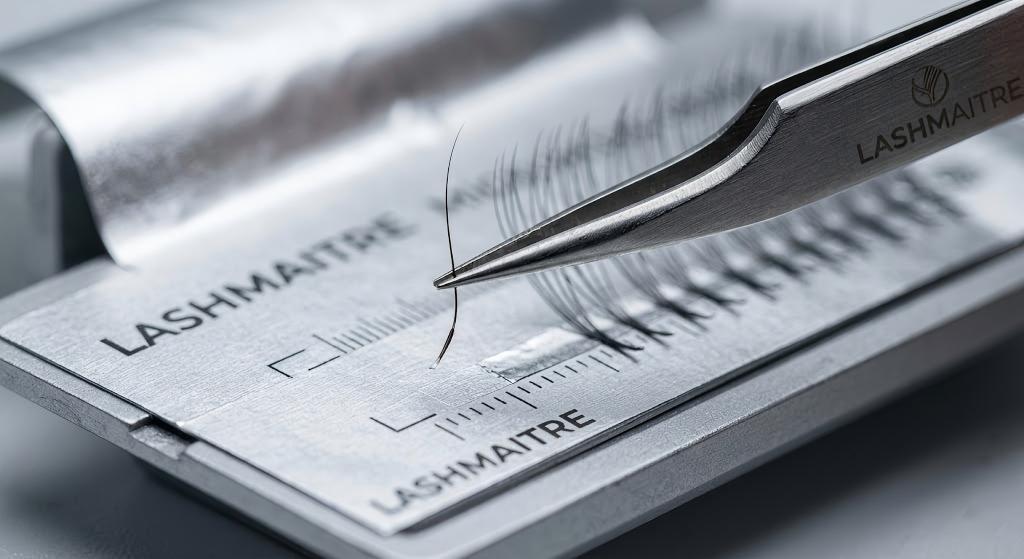
Whitepaper: Traction Alopecia, PBT Weight Ratios, and the “Will My Eyelashes Grow Back After Eyelash Extension” Liability
Document Control & Status: 1. Introduction: The Corporate Liability of Follicular Trauma In the highly competitive, premium sector of the global aesthetic market, the most profound threat to a salon franchise’s recurring revenue model is not competitor pricing; it is the physical degradation of the client’s natural biology. Every academy educator, franchise CEO, and regional…
-
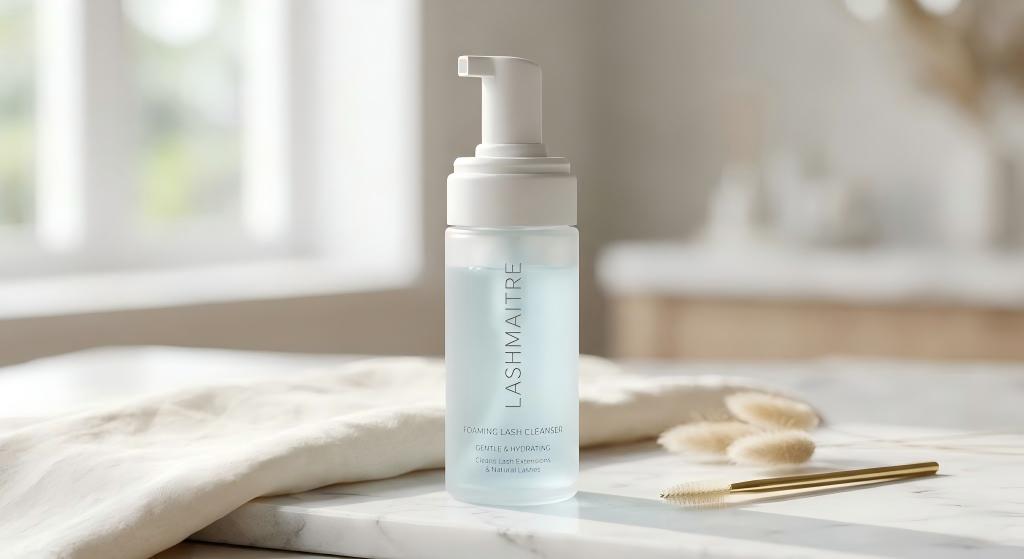
Whitepaper: Ocular Toxicology and Liability Management – Mitigating Blepharitis From Eyelash Extensions
Document Control & Status: 1. Introduction: The Corporate Liability of Ocular Complications In the rapidly expanding global aesthetic market, the profitability of a high-end salon franchise is deeply dependent on maximizing the Lifetime Value (LTV) of each client. However, this recurring revenue model is under constant threat from material-induced medical complications. Among the most prevalent…
-

7 Critical Supply Chain Secrets to Dominate the Blue Eyelash Extensions Market: A B2B Procurement Whitepaper
Document Control & Status: 1. Introduction: The High-Margin Potential of Blue Eyelash Extensions In the contemporary landscape of professional cosmetic services, the commoditization of standard black lashes has driven B2B procurement directors and salon franchise owners to desperately seek new avenues for premium upcharging. Offering specialized, avant-garde aesthetic services, such as seamlessly integrated blue eyelash…
-
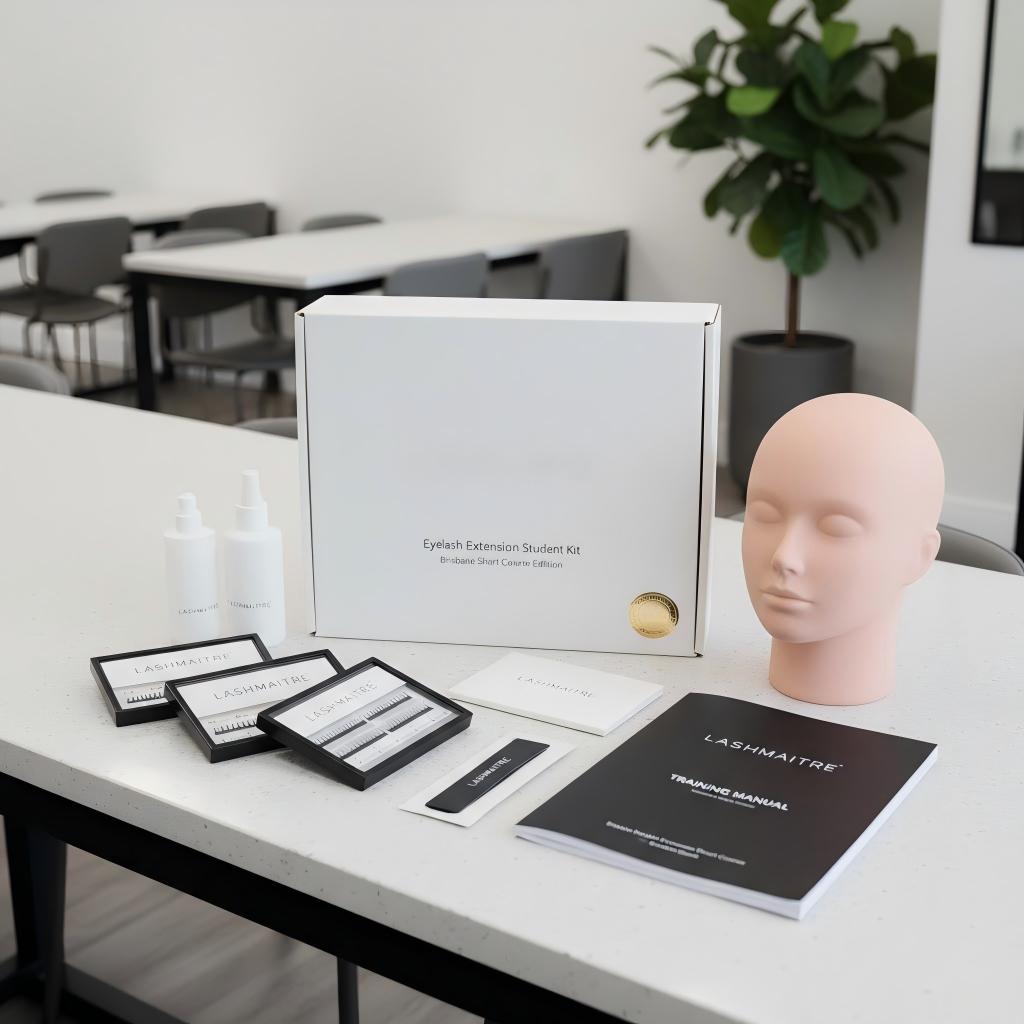
Academy Profitability: The B2B Supply Chain Guide for a Brisbane Eyelash Extension Short Course
Article Management: 1. The Procurement Reality of a Brisbane Eyelash Extension Short Course In the highly lucrative Australian cosmetic education market, launching a brisbane eyelash extension short course requires more than just an experienced instructor; it requires an absolutely flawless supply chain. Many academy founders falsely believe that student frustration and low graduation rates are…
-
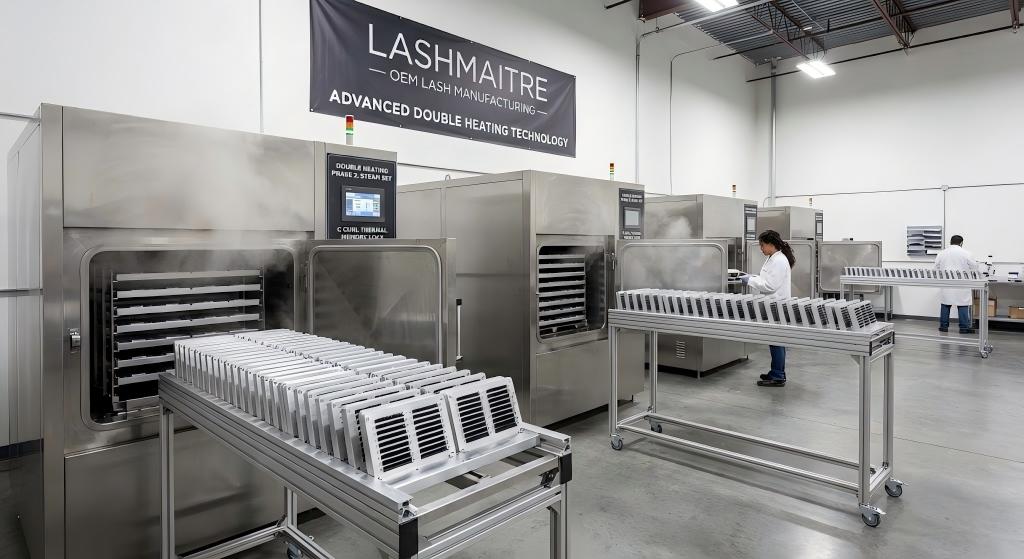
The B2B Science of C Curl Eyelash Extensions: Thermal Memory, Adhesion Physics, and Salon Profitability
Article Management: 1. The Commoditization Trap of C Curl Eyelash Extensions In the professional eyelash industry, the c curl eyelash extensions represent the absolute foundational baseline of any salon’s inventory. Designed to mimic the natural upward sweep of a perfectly applied mechanical eyelash curler, the C curl is universally applicable across almost all client eye…
-
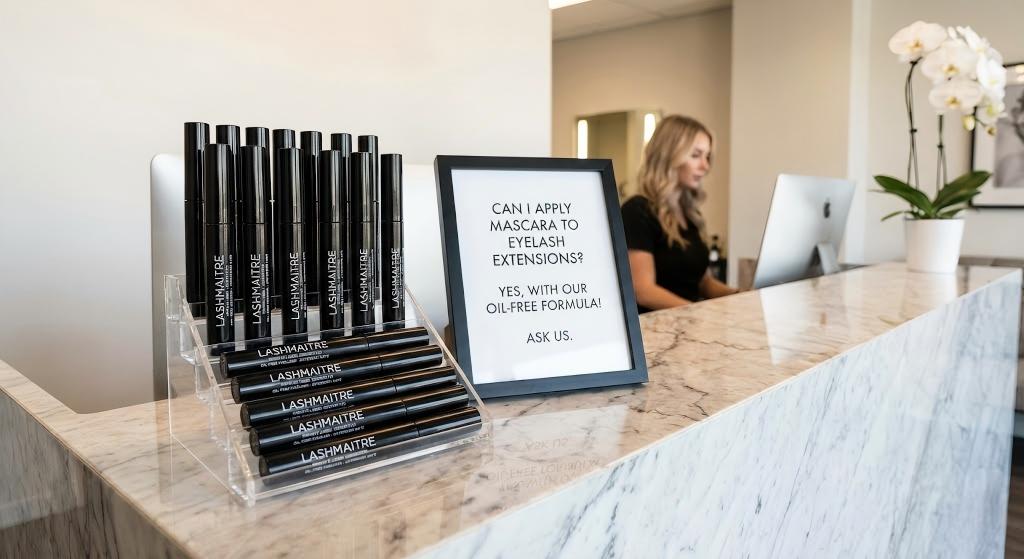
Maximize Salon Revenue: Can I Apply Mascara to Eyelash Extensions? A B2B Retail Guide
Article Management: 1. The Golden Retail Opportunity: Can I Apply Mascara to Eyelash Extensions? In the hyper-competitive beauty industry, the most successful salons do not just sell time and services; they sell comprehensive, high-end cosmetic solutions. Every master educator, salon owner, and working lash artist has encountered the exact same anxious question from a first-time…
-
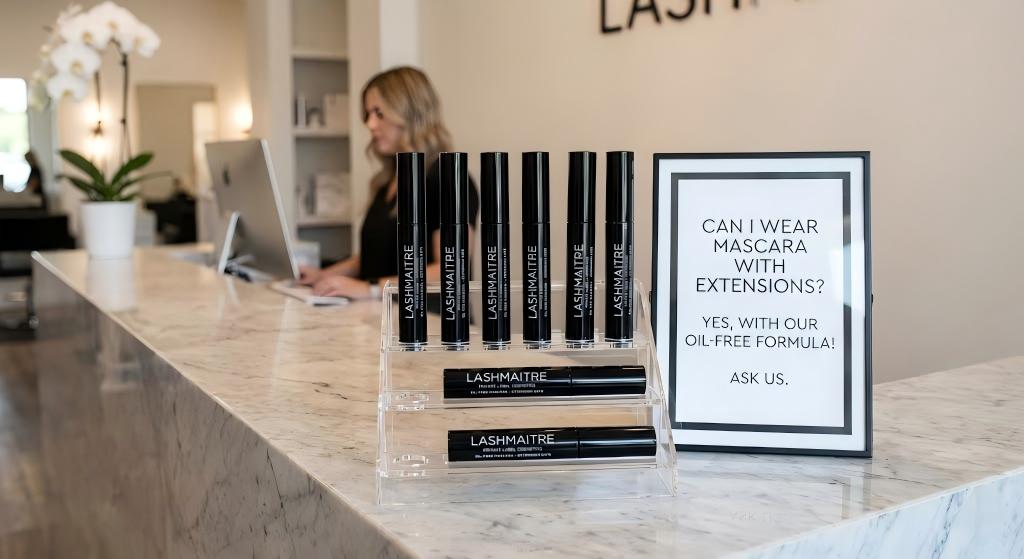
Maximize Salon Revenue: Can I Wear Mascara With Eyelash Extensions? A B2B Retail Guide
Article Management: 1. The Golden Retail Opportunity: Can I Wear Mascara With Eyelash Extensions? In the hyper-competitive beauty industry, the most successful salons do not just sell time and services; they sell comprehensive, high-end cosmetic solutions. Every master educator, salon owner, and working lash artist has encountered the exact same anxious question from a first-time…
